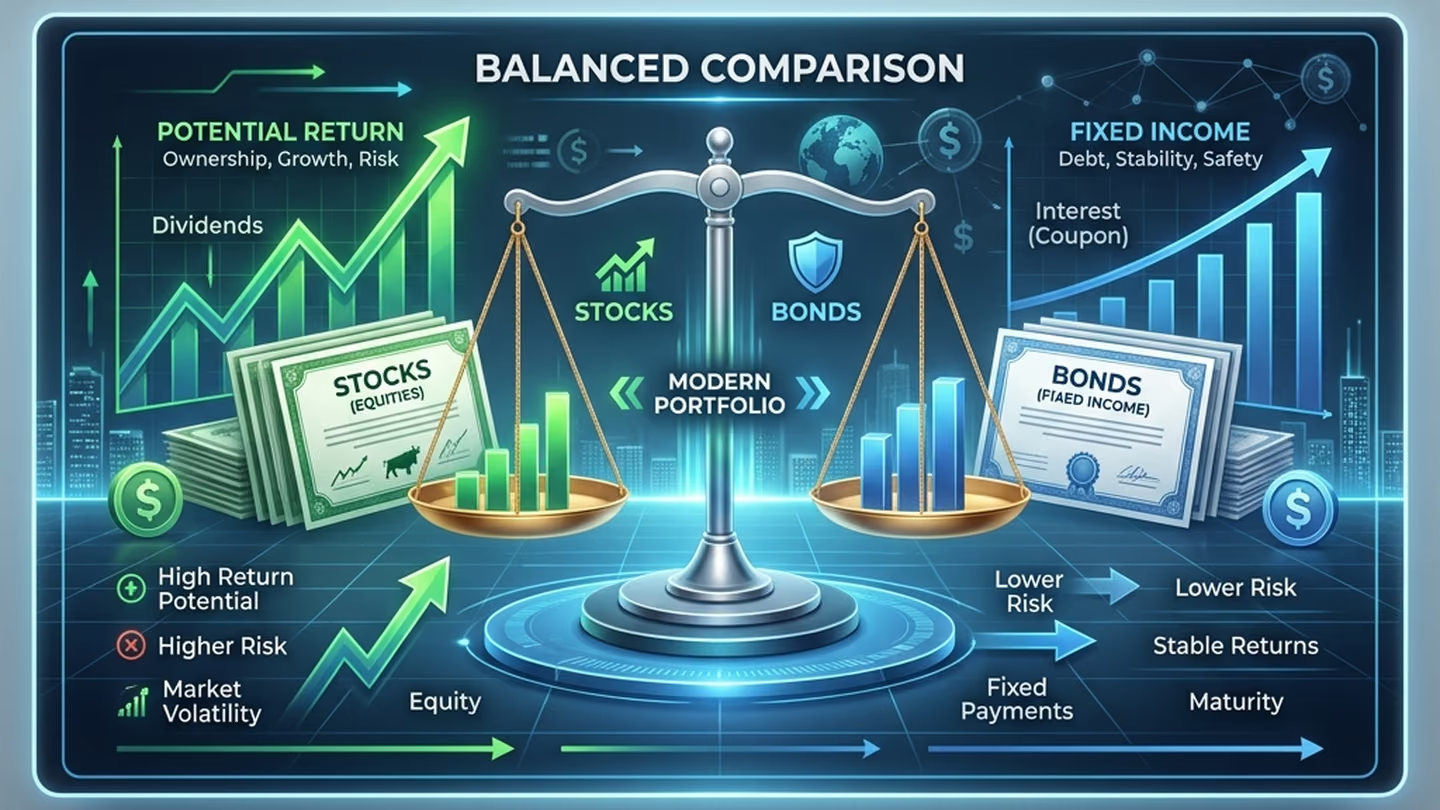
Stocks vs Bonds: What’s the Difference and How Much of Each Should You Own?
Almost every investment decision comes down to one question: how much should you put in stocks, and how much in bonds?
The answer shapes how fast your money grows, how much it fluctuates in bad years, and whether you can stay invested when markets get uncomfortable.
Here’s what actually separates the two—and how to think about the right mix.
What Is a Stock?
A stock represents ownership in a company. When you buy a share, you’re not lending money—you’re buying a piece of the business.
That ownership creates two potential returns:
- Price appreciation: if the company grows, your shares become more valuable.
- Dividends: some companies distribute profits directly to shareholders.
But ownership comes with risk. If the company struggles, your investment can lose value. If it fails entirely, shareholders are paid last—after all debts are settled—so you may get nothing back.
What Is a Bond?
A bond is a loan. When you buy one, you’re lending money to a government or company.
In return, you receive:
- Regular interest payments (the coupon)
- Your original investment back at a fixed future date (maturity)
Because bondholders are lenders, they get paid before shareholders if something goes wrong. That priority is a big reason bonds are generally considered safer.
The trade-off is inflation: if inflation exceeds the bond’s yield, your purchasing power can quietly decline over time.
The Core Difference
The simplest way to understand it:
- Stocks = ownership
- Bonds = lending
That single distinction explains everything else—returns, risks, and behavior in different market conditions.
Why Stocks Are Riskier—and Valuable
Stock prices move constantly, sometimes sharply, based on business performance, interest rates, and investor sentiment.
That volatility is the cost of higher returns.
Over long periods, U.S. stocks have historically returned around 9–10% annually before inflation, but the path is uneven, with strong gains in some years and steep losses in others.
This long-term growth is driven by compounding: the longer your money stays invested, the more powerful the effect becomes.
Why Bonds Matter
Bonds don’t offer the same growth. Their value is more about stability and income than rapid appreciation.
A typical high-quality bond might yield a fixed rate, and that’s roughly the return you can expect if held to maturity, assuming no default. High-quality bonds also tend to move less than stocks and may hold up better during market downturns.
More importantly, bonds provide behavioral stability. A smoother portfolio makes it easier to stay invested during downturns—which is often the difference between strong and poor long-term results.
A Simple Example
Consider a typical market downturn:
- 100% stocks: your portfolio might drop 20–25% in a bad year.
- 60% stocks / 40% bonds: losses might be closer to 12–15%, because bonds help cushion the fall.
The all-stock portfolio will outperform in strong markets. But the balanced portfolio is designed to make difficult periods more manageable.
How Much of Each Should You Own?
There’s no universal answer, but a few practical guidelines can help.
Time horizon matters most. Money you won’t need for 20–30 years can usually be heavily invested in stocks. Money needed within 3–5 years should lean more toward bonds or cash.
Risk tolerance matters just as much. If a 30% drop would cause you to panic and sell, a more conservative mix is likely the better choice—even if it means slightly lower long-term returns.
As a rough starting point:
- Aggressive (long horizon): 80–100% stocks
- Balanced: 60–80% stocks
- Conservative or near-term needs: 20–50% stocks
These are not rules, but useful anchors.
The Bottom Line
Stocks and bonds are not competing choices—they serve different roles.
Stocks drive long-term growth. Bonds provide stability and help you stay invested when markets turn volatile.
The goal is not to find the “best” asset. It’s to build a mix you can stick with through both good markets and bad ones. Over time, that consistency is what drives real results.
Read Next
- What Is Compound Interest? How it can work for you? — the math behind why starting early with either asset class matters so much
- Good Debt vs Bad Debt — What’s the Difference? — get high-interest debt handled before building a stock/bond portfolio