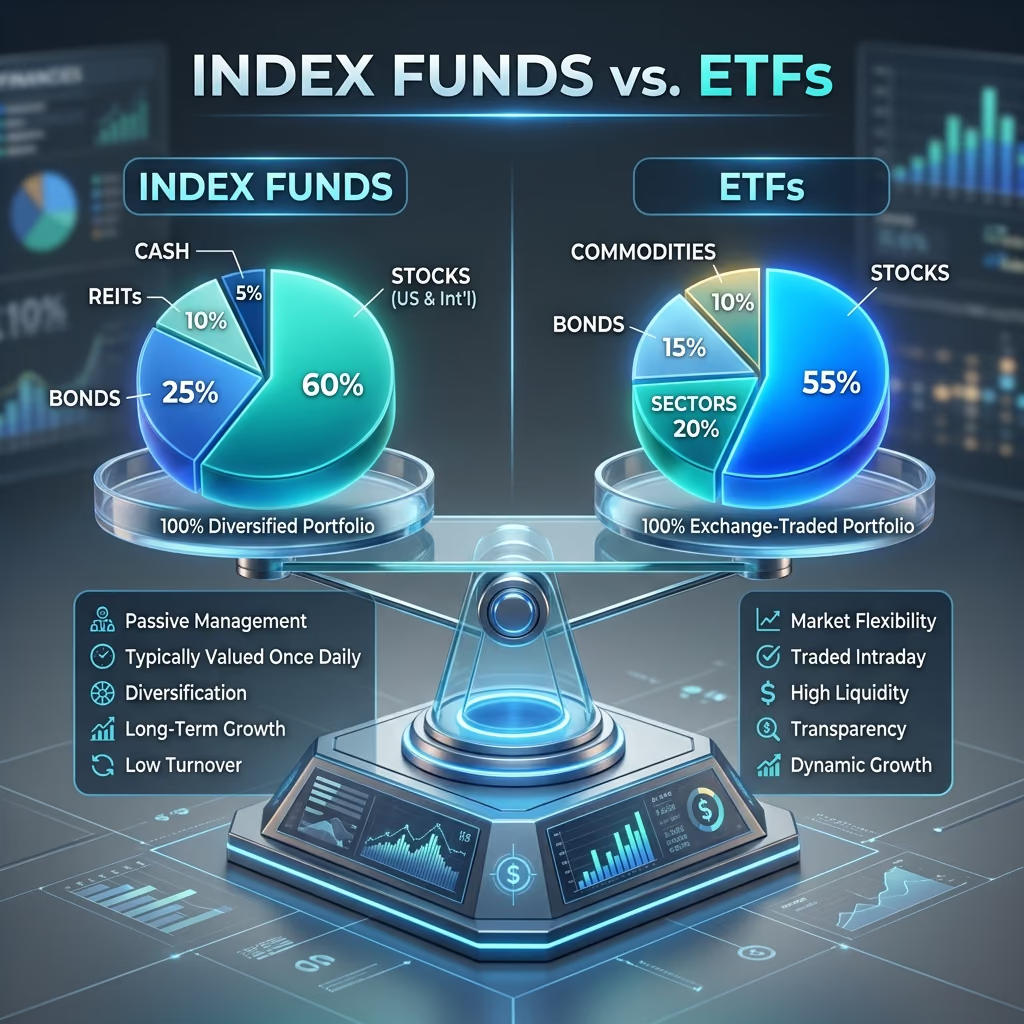
Here’s the part that confuses almost everyone starting out: an index fund and an ETF tracking the same index can hold the exact same stocks, in the exact same proportions, and charge nearly the exact same fee. Vanguard’s S&P 500 index mutual fund (VFIAX) and its S&P 500 ETF (VOO) are a textbook example — same underlying holdings, nearly identical expense ratios, different wrapper.
So if the contents are basically identical, what actually separates them? It comes down to structure, not strategy — and that structure creates a handful of practical differences worth knowing before you pick one.
The core difference: how each one is built
An index fund is a type of mutual fund — you buy and sell shares directly from the fund company, and every trade happens once a day, after the market closes, at that day’s calculated price (called the net asset value, or NAV).
An ETF (exchange-traded fund) trades on a stock exchange, just like an individual stock. You buy and sell it through your brokerage account throughout the trading day, at whatever price the market sets in that moment.
Both can track the same index — the S&P 500, the total U.S. stock market, an international index — and when they do, the underlying difference is almost entirely about how you trade it and how it’s taxed, not what you actually own.
Where they actually differ
Trading flexibility. ETFs trade all day at fluctuating prices, like a stock. Index mutual funds only trade once per day, after market close, at a single price. If you’re a long-term, buy-and-hold investor, this difference rarely matters in practice.
Minimum investment. ETFs generally have no minimum beyond the price of a single share — some brokerages now even allow fractional shares, lowering the barrier further. Index mutual funds often carry a minimum initial investment, sometimes $1,000 to $3,000 depending on the fund company, though this has been trending down industry-wide.
Tax efficiency. This is the most meaningful practical difference for anyone investing in a regular taxable brokerage account. ETFs use a mechanism called in-kind creation and redemption, which generally allows them to avoid selling underlying stocks when investors cash out — meaning fewer taxable capital gains get passed on to everyone still holding the fund. Index mutual funds, by contrast, may occasionally have to sell holdings to meet investor redemptions, which can trigger a taxable capital gains distribution even for investors who didn’t sell anything themselves.
Expense ratios. Both tend to be low when tracking the same major index, and the cheapest options from either category now often sit well under 0.10% annually. ETFs have historically had a slight edge here, though the gap has narrowed — some of the lowest-cost mutual fund share classes now match their ETF counterparts almost exactly.
Automatic investing. This is where index mutual funds genuinely have the edge. Because you can buy a specific dollar amount (say, exactly $500) rather than a specific number of shares, mutual funds make recurring automatic contributions simpler. ETFs require buying whole (or fractional, if supported) shares at whatever the current price happens to be, which can complicate a fixed recurring investment amount depending on your brokerage’s fractional share support.
Does the tax efficiency difference actually matter to you?
It depends entirely on the account type:
- In a 401(k), traditional IRA, or Roth IRA — it doesn’t matter at all. These accounts are already tax-advantaged, so the ETF tax efficiency edge is irrelevant. Pick based on whichever is available and easiest to use inside your plan.
- In a regular taxable brokerage account — this is where the difference becomes real. If you’re investing outside a retirement account, the ETF structure’s tendency to avoid forced capital gains distributions can meaningfully reduce your tax bill over time, especially in a fund experiencing a lot of investor turnover.
A practical way to decide
- Pick an ETF if: you’re investing in a taxable brokerage account, want maximum tax efficiency, want to invest anytime during market hours, or don’t want to worry about a minimum investment threshold.
- Pick an index mutual fund if: you’re investing inside a 401(k) or IRA where tax efficiency doesn’t matter, you want to set up simple automatic recurring contributions of a fixed dollar amount, or your workplace retirement plan simply doesn’t offer ETF options (many don’t).
For a lot of long-term investors, the honest answer is that either choice works well, as long as you’re picking a low-cost fund tracking a broad index rather than a narrow or expensive one. The wrapper matters less than actually starting and staying consistent.
What to actually compare before choosing
Whichever type you’re leaning toward, check these specifics on the exact fund, since they vary fund-to-fund even within the same category:
- Expense ratio — the ongoing annual fee, expressed as a percentage of your investment
- What index it tracks — make sure it matches the exposure you actually want (total market vs. S&P 500 vs. international, for example)
- Minimum investment, if it’s a mutual fund
- Whether your specific brokerage or retirement plan even offers it — some 401(k) plans are mutual-fund-only
FAQ
Can an ETF be actively managed instead of tracking an index? Yes — “ETF” describes the trading structure, not the strategy. Most ETFs track an index, but actively managed ETFs exist too. Similarly, “index fund” isn’t automatically an ETF — most index funds are traditional mutual funds, though index-tracking ETFs are also extremely common.
Is one type of fund inherently safer than the other? No. Risk comes from what the fund invests in (stocks, bonds, which market, how diversified), not from whether it’s structured as an ETF or a mutual fund.
Do ETFs have trading fees? Many major brokerages now offer commission-free ETF trading, though this varies by platform — worth confirming before you trade frequently.
Should I switch my existing index mutual fund to the ETF version? Generally not worth doing purely for the tax efficiency edge if it means triggering capital gains by selling your current fund — the tax cost of switching can easily outweigh the benefit. This is more relevant when deciding where to put new money going forward.
This article is for general educational purposes and isn’t personalized financial or investment advice. Investment returns are never guaranteed — consider consulting a financial or tax professional for guidance specific to your situation.
Read Next
- Stocks vs. Bonds: What’s the Difference and How Much of Each Should You Own? — understand the two core building blocks before choosing your fund wrapper
- Investing for Beginners: How to Start With Any Budget — a step-by-step guide to placing your first investment