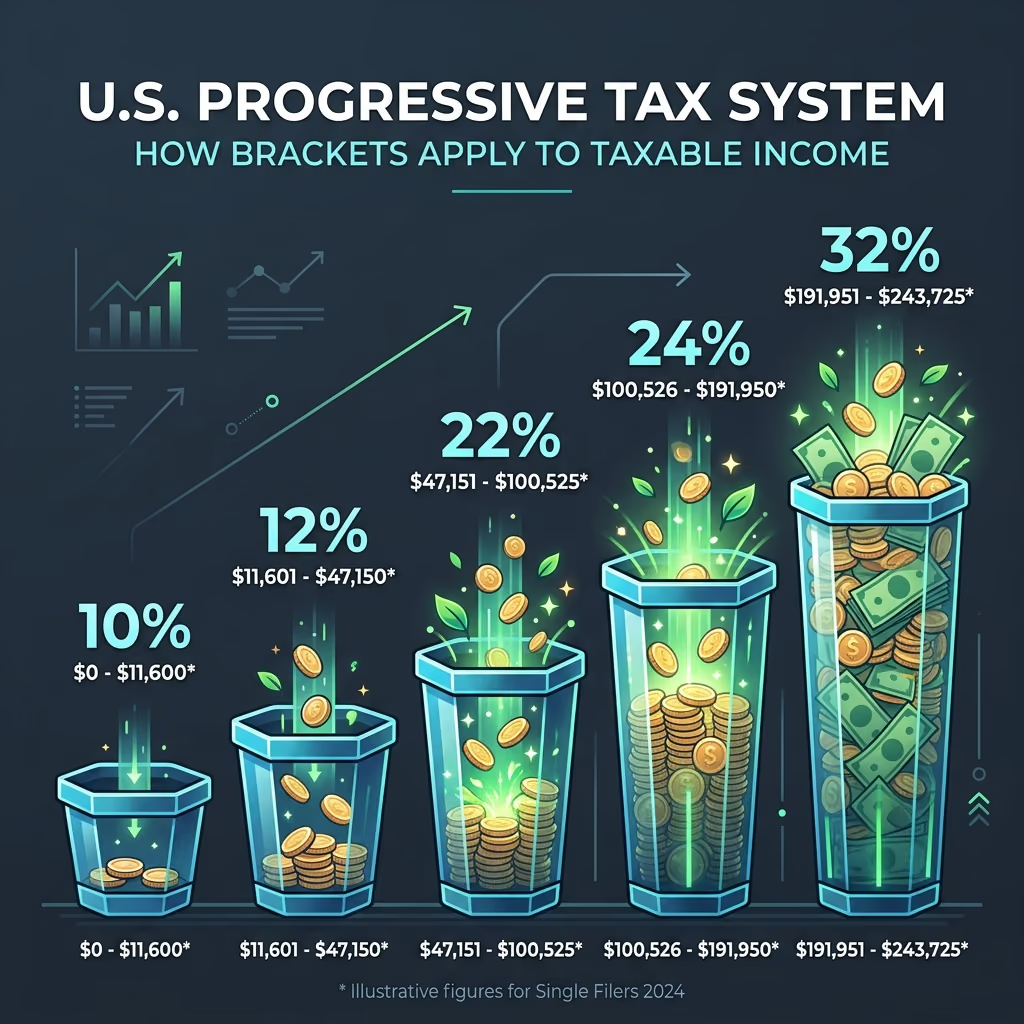
“I turned down the raise because it would’ve pushed me into a higher tax bracket.” It’s one of the most common pieces of financial advice people repeat to each other — and it’s based on a misunderstanding of how tax brackets actually work. A raise can never leave you with less take-home pay overall, because the U.S. tax system doesn’t work the way that myth assumes.
Here’s the mechanic that actually happens, plus the real 2026 federal brackets so you can see it applied to real numbers.
The core idea: only the income inside each bracket gets that bracket’s rate
The U.S. uses a marginal tax system, which means your income is taxed in layers, not as one lump sum at a single rate. Each bracket only applies to the slice of income that falls inside it — not your entire income once you cross into a higher bracket.
Think of it like filling buckets. Your first dollars fill the 10% bucket until it’s full, then the next dollars start filling the 12% bucket, and so on. Only the bucket you’re currently filling uses that bucket’s rate — the buckets already full stay taxed at their own lower rates, permanently.
The 2026 federal tax brackets (single filers)
For income earned in 2026, the seven federal brackets and their thresholds are:
| Rate | Taxable income over |
|---|---|
| 10% | $0 |
| 12% | (next bracket up from 10%) |
| 22% | (next bracket up from 12%) |
| 24% | $105,700 |
| 32% | $201,775 |
| 35% | $256,225 |
| 37% | $640,600 |
The 10% bracket starts at $0 and runs up to $12,400 of taxable income. The 12% and 22% brackets fill the space between $12,400 and $105,700, with exact cutoffs adjusted annually for inflation — check the IRS’s published tables or a tax calculator for the precise numbers for your situation. Married couples filing jointly have their own, wider set of thresholds — the top 37% rate, for example, doesn’t begin until $768,700 for joint filers, compared to $640,600 for single filers.
A real example
Take a single filer with $75,000 in taxable income. Even though their highest bracket is 22%, their effective tax rate — the actual average rate paid across their whole income — works out to roughly 10.6%, resulting in a total federal tax bill of around $7,949. That’s the gap between marginal and effective rate in action: the 22% label only describes the rate on the last portion of their income, not the whole amount.
Marginal rate vs. effective rate
Marginal tax rate is the rate applied to your last dollar of income — the highest bracket you reach.
Effective tax rate is your actual total tax divided by your total taxable income — the real average rate you paid.
Your effective rate is always lower than your marginal rate in this system, often substantially lower. This is the number that actually reflects your real tax burden, and it’s the one worth paying attention to when comparing your situation year to year — your marginal bracket alone doesn’t tell the full story.
Why “the raise pushed me into a higher bracket” doesn’t actually hurt you
Because only the income above each threshold gets taxed at the higher rate, crossing into a new bracket only affects the portion of income above that line — everything you were already earning keeps being taxed exactly the same as before. A raise, bonus, or higher-paying job might mean a chunk of the new income gets taxed at a higher marginal rate, but your total take-home pay always increases, never decreases, from earning more.
The one narrow exception worth knowing: some tax credits and deductions phase out entirely at certain income levels, which can create situations where the effective value of a raise is smaller than expected — but this is a phase-out issue with specific credits, not a bracket issue, and it never actually reduces your total after-tax income below where it started.
Why this matters for tax planning
Understanding marginal brackets is what makes pre-tax retirement contributions genuinely valuable. Contributing to a traditional 401(k) or IRA reduces your taxable income starting from the top — meaning it’s taxed at your marginal rate, which is typically your highest and most valuable bracket to reduce. For 2026, the standard deduction is $16,100 for single filers, $32,200 for married couples filing jointly, and $24,150 for heads of household — this amount reduces your taxable income before any bracket calculation even begins.
FAQ
Does earning more money ever result in lower take-home pay? No, not under the standard marginal bracket system. A small number of specific benefit or credit phase-outs can reduce the net value of additional income at certain thresholds, but your total after-tax income never decreases from earning more.
What’s the difference between taxable income and gross income? Taxable income is your gross income minus deductions (like the standard deduction) and certain adjustments — it’s the number tax brackets are actually applied to, and it’s typically meaningfully lower than your gross salary.
Do state taxes work the same way? Many states use their own marginal bracket systems, though the specific rates and thresholds vary significantly by state, and a handful of states have no income tax at all or use a flat rate instead.
How often do tax brackets change? The IRS adjusts bracket thresholds annually for inflation, which is why the same salary can technically shift into a slightly different bracket structure from one year to the next even without a raise.
This article is for general educational purposes and isn’t personalized tax advice. Tax laws and thresholds change and individual situations vary significantly — consult a qualified tax professional for guidance specific to your situation.