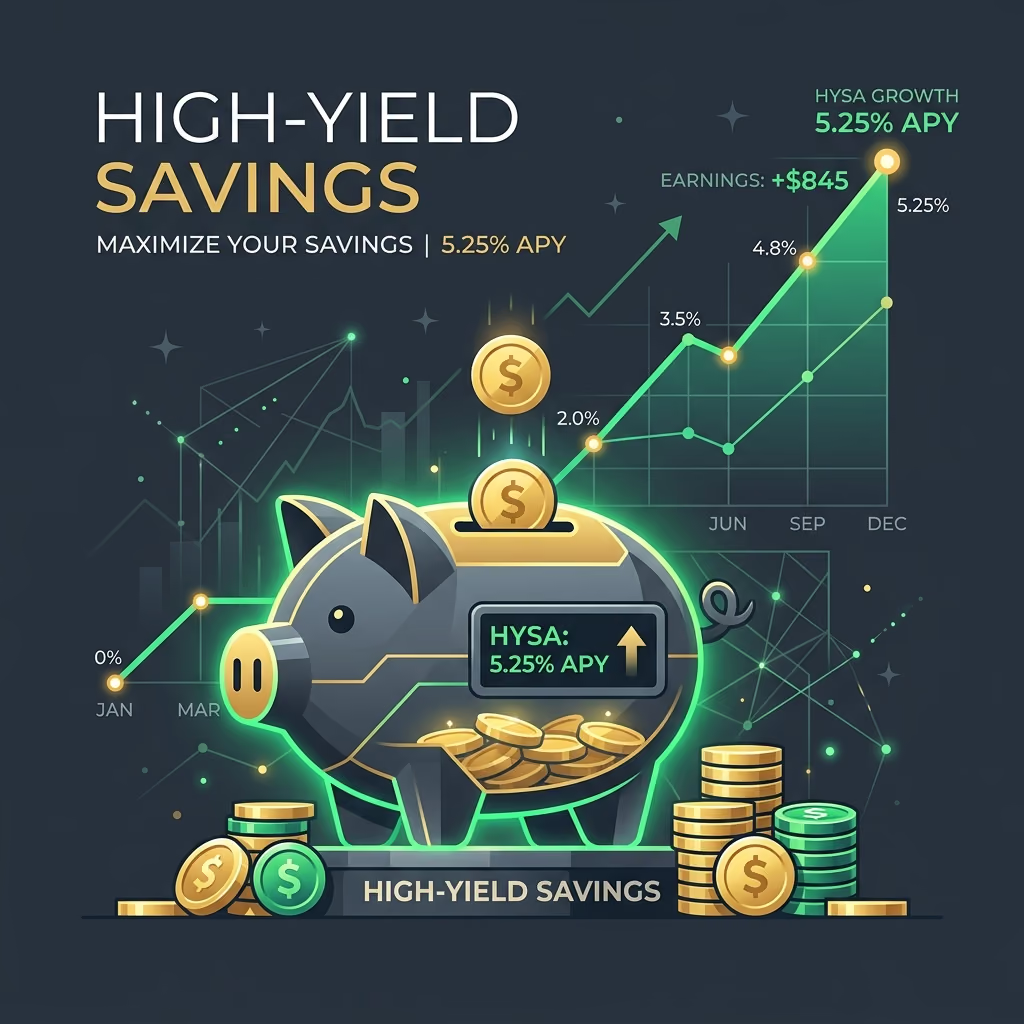
The average savings account at a traditional bank pays close to nothing — often a fraction of a percent. Meanwhile, high-yield savings accounts (HYSAs) from online banks have been paying somewhere around 4% APY for much of 2026. On a $10,000 balance, that gap is the difference between earning roughly $40 a year and earning roughly $400 — for money that’s just sitting there either way.
Here’s what actually makes these accounts different, how the rate is determined, and what to check before opening one.
What a high-yield savings account actually is
A HYSA is a standard savings account — FDIC-insured up to $250,000 per depositor, per institution, same as any bank — that pays a substantially higher interest rate than the industry average. Nearly all of the well-known high-yield options are offered by online-only banks, which is not a coincidence.
Online banks don’t operate branch networks, don’t pay for tellers or physical real estate, and pass a meaningful chunk of those savings on to depositors as higher rates. That’s the entire mechanism — it’s not a riskier product, just a leaner one.
Why the rate isn’t fixed
HYSA rates move with the Federal Reserve’s federal funds rate, which is why your APY isn’t locked in the way a CD’s rate is. When the Fed raises rates, HYSA yields tend to follow within weeks. When the Fed cuts, banks typically lower their savings APYs too, sometimes faster than they raised them.
This means the rate you see advertised today is not a promise for next year — it’s a snapshot. Some HYSAs also advertise a promotional rate for new customers that drops to a lower standard rate after an introductory period, so it’s worth checking whether an attractive number is permanent or temporary before opening an account based on it.
What to actually check before choosing one
The real, ongoing APY — not just the headline number. Some banks advertise a high promotional rate that only applies for the first few months, or only on balances above a certain threshold. Read past the headline rate to the fine print on how long it lasts and what it requires.
Minimum balance requirements and fees. The strongest HYSAs typically charge no monthly maintenance fee and require no minimum balance to earn the advertised rate. If an account requires you to maintain a large balance to unlock its best rate, compare that against a no-minimum option paying slightly less — the difference is often not worth the constraint.
How easily you can access your money. HYSAs are liquid — you’re not locking money away like a CD — but transfers to an external checking account typically take one to three business days rather than being instant. If you might need same-day access to a meaningful portion of your savings, factor that delay in.
Whether it’s actually FDIC-insured (or NCUA-insured for credit unions). This should be non-negotiable. It’s what makes a HYSA fundamentally different from a brokerage account or a money market fund — your principal is protected up to $250,000 per depositor, per institution, regardless of what happens to the bank.
Compounding frequency. Most HYSAs compound daily, which produces a very slightly better real return than monthly compounding at the same stated APY. Learn more about how compound interest accelerates growth over time.
HYSA vs. other places to park cash
| Account type | Typical liquidity | FDIC/NCUA insured | Rate stability |
|---|---|---|---|
| Traditional savings account | High | Yes | Low, usually near 0% |
| High-yield savings account | High | Yes | Variable, follows the Fed |
| Money market account | High, sometimes with check-writing | Yes | Variable, similar to HYSA |
| Certificate of Deposit (CD) | Low — penalty for early withdrawal | Yes | Fixed for the term |
A HYSA sits in a useful middle ground: meaningfully better yield than a traditional account, without giving up the liquidity a CD requires you to sacrifice.
Where a HYSA actually fits in your money plan
The most common — and most sensible — use for a HYSA is your emergency fund and any short-to-medium-term savings goal (a car, a wedding, a house down payment within the next few years). Money you might need on short notice shouldn’t be exposed to market risk in a brokerage account, but it also shouldn’t sit earning near-zero interest at a traditional bank while inflation quietly erodes its value.
A reasonable rule of thumb: keep one to two months of everyday spending in your regular checking account for convenience, and move everything else you’re not actively investing — emergency fund, short-term goals — into a HYSA where it can actually earn something while staying fully accessible.
A quick note on taxes
Interest earned in a HYSA is taxable income, reported to you (and the IRS) on a 1099-INT if you earn more than $10 in a year from that account. It doesn’t get special tax treatment the way long-term capital gains do — but even after accounting for taxes, a 4% APY account still meaningfully outperforms a traditional savings account paying a fraction of a percent.
FAQ
Is a high-yield savings account safe? Yes, as long as it’s FDIC-insured (or NCUA-insured at a credit union) and you stay under the $250,000 per-depositor, per-institution coverage limit. The “high yield” part doesn’t come with extra risk — it comes from lower overhead at online banks.
How is a HYSA different from a money market account? They’re similar in rate and liquidity. The main practical difference is that some money market accounts offer check-writing or debit card access, while most HYSAs are transfer-only.
Can I lose money in a HYSA? Not from market risk — your balance doesn’t fluctuate with markets. The only way your money loses real value is if the interest rate falls below the inflation rate for a sustained period, which is a purchasing-power risk, not a principal risk.
Is it worth switching banks for a better rate? Often yes, especially if your current savings account is paying close to 0%. Opening a new HYSA typically takes a few minutes online, and most let you fund the account via a simple transfer from your existing bank.
How many withdrawals am I allowed per month? The federal rule that used to cap savings withdrawals at six per month was suspended in 2020, though some banks still apply their own limits or fees for excessive transfers — worth checking a specific account’s policy before assuming unlimited access.
This article is for general educational purposes and isn’t personalized financial advice. Interest rates are variable and change frequently — verify current rates directly with any institution before opening an account.